Most homes and buildings in New York City have flat roofs, and most flat-roof leaks come down to a short list of usual suspects: water that sits and doesn't drain, damaged or aging membrane, and failed flashing where the roof meets a wall, chimney, or vent. The good news is that a flat roof rarely fails everywhere at once, so if you catch the problem early, a targeted repair usually beats a full replacement. The trick is knowing what you're looking at, and not letting a small leak sit until it soaks the whole roof.
Here's a plain-English rundown of what goes wrong on NYC flat roofs, how each one gets fixed, and how to decide between repairing and replacing.
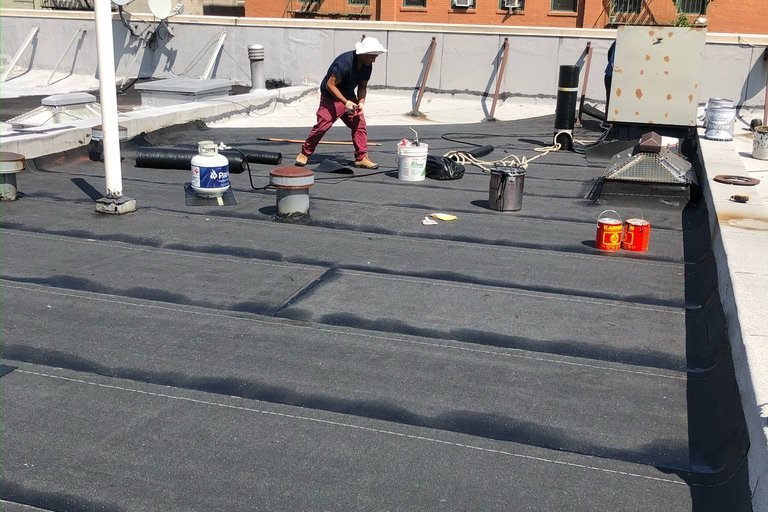
A "flat" roof isn't truly flat, it's built with a slight slope so water runs to the drains. When that slope is off, or a drain clogs, water collects and just sits there. Roofers have a specific definition for when this becomes a problem: water that remains on the roof for more than 48 hours after it rains is problematic ponding.
Why it matters: standing water slowly breaks down the roofing membrane, adds weight to the structure, and finds any weak point to seep through. On older NYC buildings where the membrane may already be tired, a shallow-looking puddle can turn into membrane deterioration, leaks, and mold. Left long enough, in severe cases it becomes a structural concern, because water is heavy and a low spot only gets lower as the deck sags.
clear and repair the drains first, since a clogged drain or scupper is often the whole problem. If the slope itself is wrong, tapered insulation can be added to re-establish proper drainage toward the drains. The goal is simple: get water moving off the roof within a day of any storm.
The membrane is the actual waterproof skin of your roof. In NYC that's usually EPDM (black rubber, very common), TPO or PVC (single-ply), or built-up and modified bitumen (the layered asphalt type). Whatever it is, it takes a beating from sun, temperature swings, foot traffic, and debris, and a large share of flat-roof failures trace back to it, with industry research putting membrane damage behind up to 40% of flat-roof failures.
Common membrane issues:
small punctures and splits can be patched with compatible membrane material and properly sealed. Failed seams get re-welded or re-sealed. But if the membrane is blistering and cracking across large areas, that's age, and patching becomes a losing game against replacement.
Here's the one that catches homeowners off guard. Flashing is the metal or membrane that seals the transitions, where the roof meets a parapet wall, a chimney, a vent pipe, or the edge. Flashing often deteriorates faster than the main roof surface, and when it fails, water gets in behind the roofing entirely, then travels before it ever shows up inside.
A widely-shared roofing video online showed exactly this: a flat deck so waterlogged the inspector was practically walking on a wet sponge, and the culprit was the complete absence of flashing where the roof met a vertical wall. No flashing, no caulk, nothing keeping water out at the seam. The waterlogged roof was the symptom; the missing flashing was the cause.
re-flash the transition properly with the right material and seal it. This is one of the most common and most fixable causes of a flat-roof leak, and it's often mistaken for a "roof problem" when it's really a "detail problem" at the edges. On NYC rowhouses and brownstones, the parapet walls are a frequent trouble spot, since the coping and flashing up there take the full brunt of the weather.
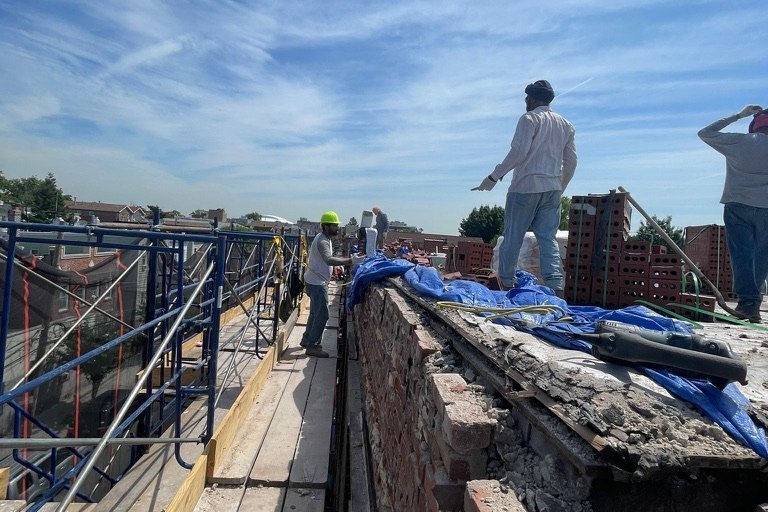
When you do need bigger repairs or a replacement, it helps to know the common systems:
There's no single "best," it depends on your building, budget, whether the roof gets foot traffic, and whether you want a reflective surface. A good roofer matches the system to the roof rather than installing whatever they happen to stock.
Flat roofs make leaks tricky because water travels, the stain on your ceiling is often nowhere near where the water actually got in. A systematic approach beats guessing:
For anything beyond an obvious puncture, moisture-detection tools and an experienced eye save you from patching the wrong spot, which is the most common way people waste money on a flat roof.
A flat roof generally lasts 10 to 25 years depending on the material and how well it's maintained. As a rough guide:
The expensive mistake is ignoring "minor" ponding or a small leak. Water damage compounds: what's a cheap patch today becomes soaked insulation, rotted decking, and structural repairs later. A yearly inspection, and one after any major storm, is the cheapest insurance a flat roof can have.
At Roofing Contractor NYC we diagnose flat-roof leaks properly, finding where the water actually enters, not just where it shows up, and fix the real cause, whether that's ponding and drainage, a torn membrane, or failed flashing. We work on EPDM, TPO, PVC, and modified bitumen roofs across the five boroughs.